


Our newest guide clears up what a Google review alias can and cannot hide. Plus, Google is testing bigger LSAs, adding review friction, and rolling out a spam update. Judge the changes by qualified calls and booked appointments.
In this issue:
A review alias is not a privacy shield
Some review readers now hit a sign-in gate
Do not overreact to spam-update turbulence
AI visibility needs a diagnosis, not another dashboard
Specific offer names may help the right buyer decide
Bigger LSAs put your photos and proof on display
The Deep Dive
A review alias is not a privacy shield

Source: How to Leave an Anonymous Google Review (and What People Can Still See)
Our latest guide explains a distinction worth making in your review requests: Google Maps lets people use a custom public name and photo, but the review still stays public and connected to their Google Account.
That option is not new this week. The guide explains how it works and what an alias does not hide, including revealing details in the review or other public contributions.
For a local business, the practical move is to respect that choice. Invite honest feedback without incentives or pressure. Do not promise that a customer can leave a confidential or account-free Google review.
The Real Reason This Matters: People may hesitate to review a sensitive local service. Clear expectations help them decide without a false promise of anonymity.
Key Takeaway: A different display name can reduce public identification, but it does not make the review private.
Action Step: Check your review-request wording. Offer a private feedback channel too, and respond publicly without guessing or revealing the reviewer’s identity.
Top Stories
Some review readers now hit a sign-in gate
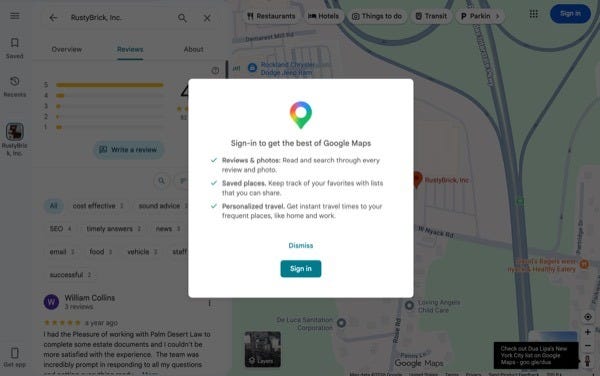
Source: Google Maps Now Requires Sign In To Read All Reviews & More
Search Engine Roundtable directly observed Google Maps asking users to sign in when they tried to read all reviews or change the sort order. Some initial review content can still appear, so Google reviews have not disappeared.
The article suggests the change may discourage scraping, but Google’s motive is not confirmed. The immediate issue for a local business is customer friction. A prospect checking your reputation may see less before being asked to log in.
That makes it worth testing the same path your prospects use and keeping permissioned, truthful testimonials on your website as another source of proof.
The Real Reason This Matters: Even a small obstacle between a prospect and your best reviews can affect trust before a call or booking.
Key Takeaway: Your reputation should be easy to verify in more than one place.
Action Step: Open your Maps listing in a signed-out mobile browser, try to read and sort reviews, and confirm that your website also shows current, permissioned customer proof.
Do not overreact to spam-update turbulence

Source: Google Rolls Out September 2026 Spam Update Globally
Google started its September 2026 spam update on September 24 across all languages. The company estimated that rollout could take up to two weeks, and it did not name a specific tactic as the target.
That means a ranking swing on September 30 is not a final diagnosis. It also does not prove Google is targeting AI-written content, and the reporting does not establish an effect on Maps rankings.
For a local business, the sensible response is careful measurement. Separate temporary organic movement from an actual drop in qualified leads before rewriting pages.
The Real Reason This Matters: A rushed response can damage useful pages while an update is still moving through search results.
Key Takeaway: Annotate the rollout, compare like-for-like data, and wait for a stable pattern.
Action Step: Mark September 24 in your reports. Review affected pages, qualified organic leads, and Google’s spam policies, but hold mass rewrites until the rollout settles.
AI visibility needs a diagnosis, not another dashboard

Source: AI Visibility Data Paralysis: How to Get Unstuck
Ahrefs lays out four distinct problems: your business is absent from recommendations, a competitor keeps winning, AI answers contain incorrect facts, or your content cannot be accessed. Those are different failures, and treating them as one score creates busywork.
The useful local adaptation is to group prompts around real business questions: services in a location, comparisons, and factual details such as hours or eligibility. Track a baseline for at least a week before interpreting a pattern.
You do not need a particular paid tool to begin. A small, consistent question set is more useful than a large pile of disconnected screenshots.
The Real Reason This Matters: You cannot fix AI visibility until you know whether the problem is discovery, preference, accuracy, or access.
Key Takeaway: Build measurement around customer questions, not a vague visibility score.
Action Step: Choose five service and location questions. Record which businesses appear, whether your facts are correct, and what source pages are cited for seven days.
Specific offer names may help the right buyer decide
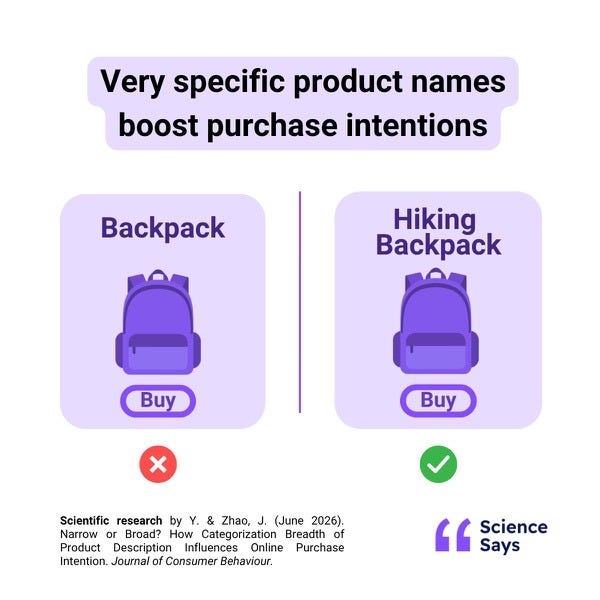
Source: Make product names very specific
Science Says summarizes the Journal of Consumer Behaviour research covering four product experiments. Narrow use-case descriptions increased stated purchase intentions by as much as 9.5%, with stronger effects among shoppers seeking a specific product.
That was not a test of local service bookings, so a contractor, dentist, or med spa should not expect the same lift. The idea is still worth a controlled test: a clear offer name can help a prospect quickly see whether a service fits the problem they need solved.
Measure qualified booked appointments instead of clicks on a clever name.
The Real Reason This Matters: A vague service label makes prospects do the work of deciding whether your offer fits.
Key Takeaway: Specificity can improve self-selection, but the effect on local leads is still a hypothesis.
Action Step: Test one problem-specific service heading against your current version, then compare qualified appointment rates rather than assuming a 9.5% lift.
Bigger LSAs put your photos and proof on display
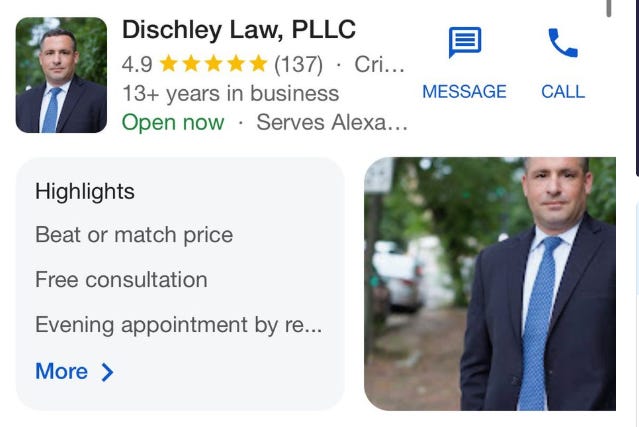
Source: Google tests bigger Local Services Ads
Google is testing a larger Local Services Ads format with bigger images and a highlight box beneath the main listing. Anthony Higman spotted the test, which could give LSAs even more visual space above other search results.
This is a test, not a confirmed universal rollout, and there is no evidence that a larger ad improves lead quality. More attention can expose weak photos, vague highlights, or slow call handling.
The Real Reason This Matters: If Google gives LSAs more screen space, the quality of your visible proof and your response process will matter more.
Key Takeaway: Treat the ad as a storefront, then measure whether that storefront produces qualified appointments rather than extra noise.
Action Step: Review your LSA photos and highlights on mobile. Then check missed-call rate, qualified-call rate, and booked appointments before calling any layout change a win.
🌶️ Spicy Take: Your landing page probably needs less
Edward Sturm’s new compilation uses older case studies to argue for fewer calls to action, fewer form fields, and simpler copy. The examples do not prove every local landing page will double conversions.
My take: most local pages do not need another badge, button, pop-up, or paragraph. They need one obvious next step. Simplifying does not mean hiding the service area, price context, or qualification requirements that keep bad leads out.
Cut clutter, keep the facts a serious prospect needs, and judge the result by qualified jobs rather than raw form totals.
Source: Edward Sturm
Quick Wins
Test your mobile action buttons. Google is testing two button rows on mobile local panels. Test call, website, and booking links. (Search Engine Roundtable)
Check service-area map pins before editing. A reported bug puts some hidden-address service businesses in the ocean. Screenshot it, contact support, and avoid unnecessary address edits. (Search Engine Roundtable)
Search your business name for AI answers. AI Overviews returned for a limited sample of large-brand searches. Check your brand query and correct inaccurate facts on pages you control. (Search Engine Roundtable)
Give AI one current fact sheet. Keep approved offers, service areas, claims, and facts in one maintained document. Use it for drafts, then review before publishing. (BrightLocal)
Make priority service pages retrievable. Check status codes, noindex tags, robots rules, and firewall behavior on priority URLs. Fix accidental blocks without disabling sitewide security. (Ahrefs)
Make service-page facts easy to find. Whitespark highlights descriptive patterns in AI-cited content, not guaranteed ranking causes. Add clear service headings, specific local facts, and a useful comparison. (Whitespark Local Insider)
Give ChatGPT Ads a narrow test. The channel remains experimental. Define one qualified-lead goal and matching landing page before moving budget. Do not assume universal local ROI. (Search Engine Land)
Let me help you “Get More Leads”
Whenever you’re ready, book a 15-minute Help Me Get More Leads call below. I will help you spot the biggest leak and the next practical fix.