


This week is about turning signals into better decisions: competitor complaints can expose questions your own marketing should answer, AI assistants may start calling your front desk, and ad platforms keep asking for cleaner proof of lead quality.
In this issue:
Your competitors’ worst reviews can sharpen your best promise
Train your front desk for an AI caller
Your brand search may answer before the click
Keep promotions out of your GBP listing fields
Quick wins
The Deep Dive
Your competitors’ one-star reviews are a free marketing brief

Source: Your Competitors’ One-Star Reviews Are a Free Marketing Brief
Most local service websites make the same soft promises: quality work, great service, people who care. A one-star review can reveal the concrete worry hiding behind those words, such as an unexpected charge, a missed arrival update, or a consultation that never explained the next step.
Start small: choose three comparable competitors, one platform, one service, and a defined review window. Group related complaints, mark possible duplicates and uncertainty, then audit your own records. Test one truthful message in one placement and track raw inquiries, qualified inquiries, and bookings separately. A complaint is a clue, not proof, and no wording change guarantees more leads.
The Real Reason This Matters: Specific customer worries give you a better place to investigate than another round of generic marketing copy.
Key Takeaway: Use competitor reviews to question your own process, not to judge a rival or claim the market has spoken.
Action Step: Pick one recurring concern, audit your own delivery records, and write a promise only after you can prove the process behind it.
Top Stories
Train your front desk for an AI caller
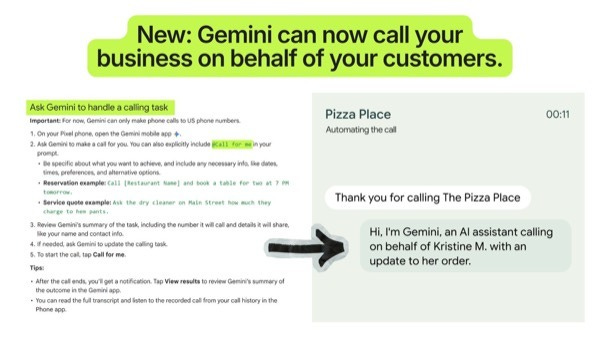
Source: Google’s AI assistant is about to start calling businesses
Whitespark reports that Google is testing Gemini “Call for Me” on Pixel 11 in the United States. The assistant calls from the customer’s own number, identifies itself as AI, and can ask about inventory, book an appointment, or change one.
Staff should not hang up. They need to answer clearly, confirm names and times, and offer a human handoff when requests get complicated.
This is a limited test, not something every phone or customer can use. Prepare because a real customer may be waiting behind the assistant.
The Real Reason This Matters: A receptionist who treats every AI voice as spam can lose a legitimate appointment before it reaches the calendar.
Key Takeaway: Treat identified assistant calls as customer inquiries, while keeping a human handoff available.
Action Step: Call your main number, test the phone tree, and give staff a short script for confirming details from an AI assistant.
Your brand search may answer before the click
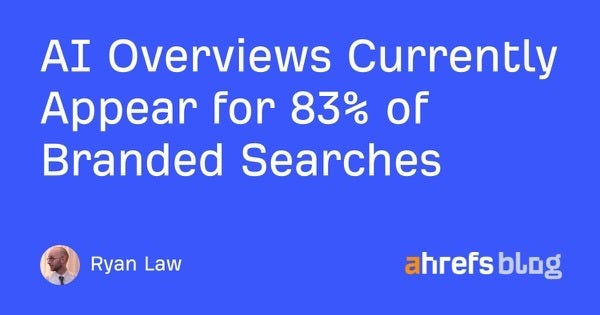
Source: AI Overviews Currently Appear for 83% of Branded Searches
In an analysis covering 232.8 million US desktop SERP crawls, Ahrefs found AI Overviews on 82.91% of its branded keyword results on September 29. Its September monthly average was 73.3%, up from 61.3% in July.
That is a broad branded keyword dataset, not a finding that 83% of local businesses get AI Overviews. It also measures whether an overview appeared, not whether the searched brand was mentioned or described correctly.
The first impression around your name can now form before a site visit. Check what it says, cites, and who appears beside you.
The Real Reason This Matters: A branded search is no longer guaranteed to be a clean path from your name to your website.
Key Takeaway: Treat AI results around your name as another reputation surface, then measure their effect instead of assuming it.
Action Step: Search your business name while signed out, save the result, inspect citations, and compare branded Search Console click-through rate over time.
Keep promotions out of your GBP listing fields

Source: Updated Google Maps Policy: What Merchants Can’t Post In Listings Or Posts
Google’s current Maps policy says merchant listing contributions cannot contain promotional pricing, time-bound offers, or direct calls to action. Offers and updates can still appear in Posts, but the content must follow the relevant policies.
Treat listing fields and Posts as separate surfaces. Keep the business description and other listing content factual. Put a compliant offer in a Post instead of forcing it into the listing.
Restricted-product rules still apply, so healthcare and wellness businesses should not use this as permission to promote regulated products.
The Real Reason This Matters: A promotion placed in the wrong field can create policy risk without making the profile more useful.
Key Takeaway: Use listing content for stable business facts and Posts for eligible, policy-compliant offers.
Action Step: Review your description and listing fields for prices, deadlines, and sales CTAs, then move only eligible offers into compliant Posts.
🌶️ Spicy Take: The testimonial you nearly skip may be the one worth testing
Edward Sturm says a testimonial video he almost withheld drove his best sales day. It is a useful anecdote, but it is still one person’s account with no controlled comparison or numerical lift.
The lesson is not that rough testimonial videos always win. It is that internal taste is a weak reason to bury authentic customer proof. Publish a truthful version where prospects make decisions, then track qualified calls, appointments, and sales against other creative.
Let the results earn the conclusion.
Source: Edward Sturm
Quick Wins
Audit the communication gaps behind complaints. A review of 1,200 Google Business Profiles across 50 industries found communication problems near the top in almost every category. The published summary does not provide full coding details, so use it to prompt an audit of missed calls, late updates, and no-shows rather than declaring a universal cause. (Whitespark Local Insider)
Match the sales channel to the decision. B2B research summarized by Science Says linked stronger sales performance with matching remote or in-person contact to offer complexity. For a high-consideration local service, test a human consult after remote intake and measure booked appointments. (Science Says)
Measure AI visibility with its limits attached. Track AI referrals, branded search, periodic prompt checks, and call or booking outcomes together. Visibility metrics are imperfect proxies and should not be presented as incremental revenue. (Ahrefs)
Make your local facts easy to reuse. A vendor-run single-brand experiment found visibility varied by query, engine, and source. Make services, locations, and credentials explicit, build credible external mentions, and treat the finding as directional for local businesses. (SE Ranking / SE Visible)
Watch healthcare review-snippet impressions. A vendor observed declines in healthcare review rich results, but Google has not confirmed a broad change. Keep accurate schema, monitor impressions, and remember reviews still support trust beyond stars in search snippets. (Search Engine Roundtable)
Test the landing page before raising spend. Google added examples such as 4xx and 5xx errors, DNS failures, broken redirects, timeouts, loops, and login barriers. Test mobile access and confirm Google AdsBot can load the destination. (Search Engine Land)
Fact-check the small AI-generated fields too. Google’s guidance now calls for manual checks of AI outputs, including titles, descriptions, structured data, and image alt text. Verify services, offers, hours, locations, and sensitive claims before publishing. (Search Engine Journal)
Annotate ranking volatility before blaming your edits. Search Engine Roundtable observed volatility from October 4 to 6 and believes it may be another phase of the spam update. Google has not confirmed that timing, so compare Search Console and lead trends before assigning a cause. (Search Engine Roundtable)
Let me help you “Get More Leads”
Whenever you’re ready, book a quick Help Me Get More Leads call. In 15 minutes, we can look at what is helping or hurting your local lead flow and what to fix next.